
Estimating Monthly Income at 100 TH/s
A 100 TH/s machine earns about $4.04 a day before fees and $3.88 after the listed 4% block-reward fee, so the month starts near $121.20 gross and $116.40 net. Whether any of it survives depends on what the machine draws: at 20 J/TH on a $0.06/kWh supply the power bill takes $86.40 of that month, leaving close to $30.00. Here is the whole estimate, line by line, at difficulty 132.76 T and a $85,294 BTC price.

Key takeaways
- 100 TH/s at difficulty 132.76 T produces about 0.00004735 BTC a day, or $4.04 at $85,294 per BTC, and $3.88 after the listed 4% fee on the block-reward component.
- Thirty days at that rate is $116.40 after fees; power at 20 J/TH and $0.06/kWh removes $86.40 of it.
- Efficiency decides the month: the same 100 TH/s leaves $51.60 at 15 J/TH and a shortfall of $13.20 at 30 J/TH.
- Uptime and difficulty both trim the total: 95% uptime costs about $5.82 a month, and an estimated +1.90% difficulty change about $2.17.
What 100 TH/s produces in a day
Income starts from your share of network hashrate. With difficulty at 132.76 T and an implied network hashrate of 950.3 EH/s, the network issues 450 BTC a day through the 3.125 BTC subsidy on 144 blocks. A 100 TH/s machine holds a small slice of that: about 0.00004735 BTC a day, which is $4.04 at $85,294 per BTC.
Fees come next, and they apply to the component they are named for. The listed 4% rate applies to the PPS-settled block reward, which leaves $3.88 a day. Transaction fees are distributed on a separate basis and are excluded from this estimate because they vary from block to block, which is also why a real month rarely matches a projected one to the cent.
Multiply the daily figure by 30 and the month is $121.20 gross or $116.40 after the listed fee. That is the number most estimates stop at, and it is the least useful one, because it describes a machine that consumes nothing.
The month, after costs
Power is the input that changes the answer most. At 20 J/TH a machine draws 2 kW at 100 TH/s, which is 48 kWh a day, or 1,440 kWh across 30 days. On a $0.06/kWh supply that is $2.88 a day and $86.40 for the month.
| Scenario | Monthly income after the listed 4% | Monthly power cost | Monthly margin |
|---|---|---|---|
| 15 J/TH, 100% uptime | $116.40 | $64.80 | $51.60 |
| 20 J/TH, 100% uptime | $116.40 | $86.40 | $30.00 |
| 30 J/TH, 100% uptime | $116.40 | $129.60 | minus $13.20 |
| 20 J/TH, 95% uptime | $110.58 | $82.08 | $28.50 |
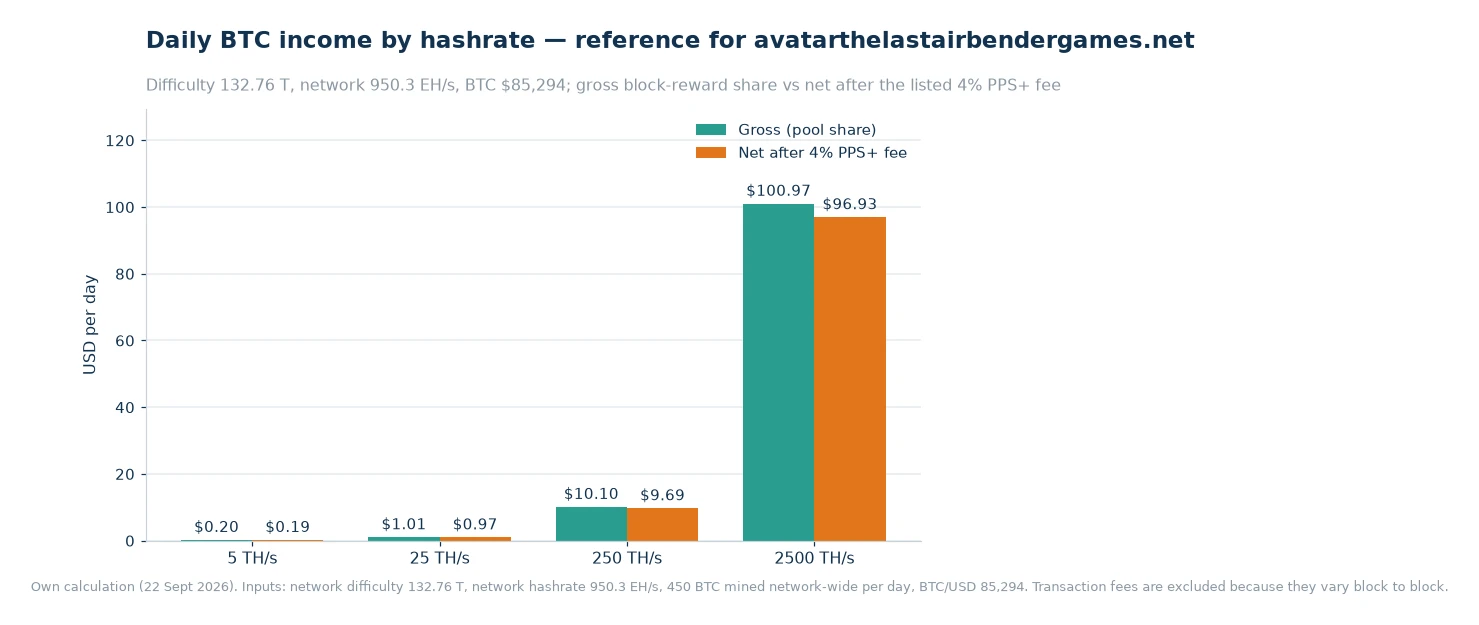
Scale is the simplest lever on the same arithmetic. At 250 TH/s the identical inputs produce $9.69 a day after the listed 4% fee, close to $290.70 for the month, while 250 TH/s at 30 J/TH draws 7.5 kW and burns 5,400 kWh over 30 days, a $324 bill that eats the whole figure. The efficiency rating keeps deciding the outcome at every size.
The first three rows hold the hardware and the power price steady and vary only the efficiency rating. Income does not move at all, because hashrate does not move. What changes is the third column, and with it the answer to whether the machine earns or costs money over a month.
Worked example
Take the middle row and walk it through. Gross income is 100 × $0.0404 = $4.04 a day. The listed 4% applies to the block-reward component, so the after-fee daily figure is $3.88, and a 30-day month gives $116.40.
Power draw is 100 TH/s × 20 W per TH/s = 2,000 W, or 2 kW. Over 24 hours that is 48 kWh, and at $0.06/kWh it costs $2.88 a day, or $86.40 across the month. Subtract it and the month nets $116.40 minus $86.40 = $30.00.
Now apply the two softer inputs. A machine that runs 95% of the time rather than 100% earns $110.58 a month and still pays $82.08 for the power it used, which trims the margin to $28.50. A difficulty adjustment of the estimated +1.90% cuts income per TH/s to $3.81 a day, or about $114.23 a month, which is $2.17 below the starting figure before any power price change.
Putting the whole estimate in one place
The arithmetic above needs four inputs: hashrate, efficiency, power price and difficulty. The ViaBTC Mining Calculator keeps price, difficulty, listed fee and effective hashrate together, so a monthly number can be regenerated on any day rather than rebuilt from notes. The Profit Calculator view applies your own kilowatt price on top, so the monthly figure describes your site rather than a generic one, and the whole estimate can be rebuilt in a minute whenever the difficulty reading changes.
Keep two references open while you do it. The pool statistics page carries the network difficulty and hashrate your projection should be using, and a multi-currency wallet view is where the hourly PPS+ credits actually accumulate, which is a useful reality check on a month that looks better on paper than in the balance.
What changes the number between months
Difficulty is the largest slow-moving input. It rose twice in the last few adjustments and is estimated at +1.90% next, and every rise reduces the BTC a fixed hashrate earns. A projection that assumes today's difficulty for twelve months will drift high, which is why the useful habit is to re-run the estimate whenever the adjustment lands rather than annually.
Uptime and curtailment are the fast-moving inputs. A machine switched off during a peak tariff window loses income for those hours but also avoids the most expensive power, and the trade is only visible once both sides sit in the same table. Firmware restarts, a failed fan and a network hiccup all show up as missing hours in the pool dashboard before they show up as a smaller payout.
Cash flow is the last thing to check, because the total and the timing are separate questions. PPS+ credits arrive hourly at current difficulty, so a 100 TH/s projection accumulates in small daily amounts that line up with a power bill. A PPLNS month instead pays after six confirmations across the last five difficulty rounds, which can leave a quiet fortnight followed by one larger credit. Both can total the same figure and still feel very different in an account.
Frequently asked questions
Is $30 a month realistic at 100 TH/s?
It is the arithmetic at 20 J/TH, $0.06/kWh and 100% uptime: $116.40 of income after the listed 4% block-reward fee minus $86.40 of power. A different efficiency rating or power price moves that margin far more than any change in hashrate.
Does the pool fee apply to the whole monthly total?
No. The listed 4% rate applies to the PPS-settled block reward, while the transaction-fee component is distributed on a listed 2% basis under PPS+, and PPLNS applies a listed 2% to both components together. The two rates act on different parts of the payout.
How much does uptime matter over a month?
Five points of uptime cost about $5.82 of income and $4.32 of power at 100 TH/s and 20 J/TH, which nets out to about $1.50 of margin. Losing a whole day costs $3.88 of income and $2.88 of power.
Build the month from the bottom up
Start with the after-fee daily figure, multiply by the days you actually expect to run, then subtract power, and only then compare machines. The order matters because income is fixed by the network while costs are fixed by your site, so every improvement has to come from the cost side. Date the difficulty reading in the note and re-run the estimate when the next adjustment lands, and the monthly number will stay close to what the meter and the payout history agree on.
Readings and sources: the ViaBTC listed fee schedule[1], pool statistics[2] and the multi-currency wallet overview[3]. Network difficulty 132.76 T, implied network hashrate 950.3 EH/s, the 3.125 BTC subsidy behind 450 BTC a day network-wide and the $85,294 BTC price were read 22 Sept 2026. The month described above is a calculation from dated inputs, not an expectation; a different power price, difficulty or uptime produces a different total, and none of these figures amount to a promise.